
Introduction
Ultrafast lasers — such as picosecond and femtosecond lasers — have found widespread applications in materials science and engineering. Advances in amplification systems have greatly propelled the field of ultrafast lasers, delivering significant benefits across various industries, particularly in materials science.
Encouragingly, scientists can now fully leverage ultrafast lasers to modify the properties of diverse materials. With their ultra-high resolution and short-pulse advantages, ultrafast lasers have become the optimal choice for precisely driving specific applications.
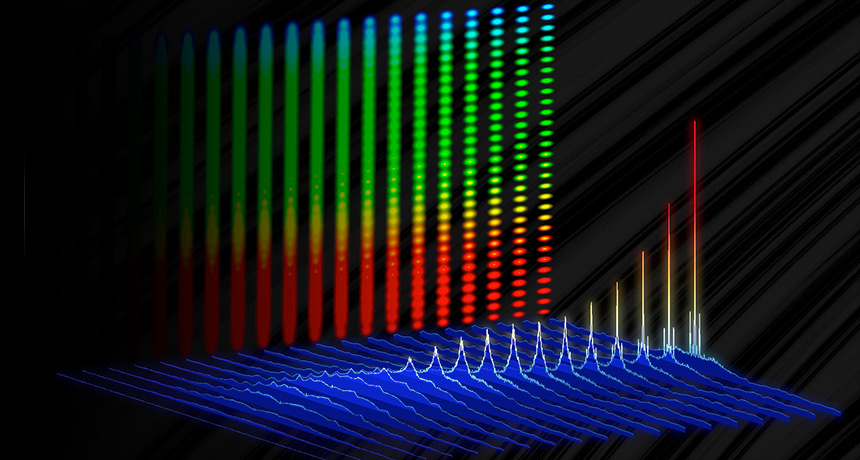
(Image credit: NIST)
Ultrafast Lasers for Nanomaterial Structuring
Recently, both research and commercial materials science sectors have developed a strong interest in using ultrafast lasers to produce nanoscale features. The global industry's focus on miniaturization, along with the emergence of novel manufacturing techniques and tools such as ultrafast lasers, has led to products that are increasingly smaller and more compact.
A recent article in the journal Nanophotonics notes that the most advanced industrial methods for shaping various materials — especially solids — involve directing high-energy ultrafast laser pulses at sufficient intensity onto surfaces to stimulate and remove material.
Beyond direct ablation, another structural phenomenon emerges when the surface is excited by ultrafast laser irradiation — transforming surface morphology into regular patterns with sub-wavelength periodicity, known as ultrafast laser-induced periodic surface structures (LIPSS).
The foundational concept critical to bulk nanostructuring involves so-called microexplosions. This concept requires stimulating high-density plasma with ultrafast laser pulses, leading to substantial electron pressure, shock waves, and the development of rare elements at multi-millibar levels. Nanoscale structures are achieved through the precise focusing of ultrafast laser beams.
The applications of ultrafast laser-fabricated nanostructures are broad and diverse. They deliver high-performance functionalities in optics, mechanics, and biology — especially when structures fall within the optical wavelength range — attributable to properties related to surface morphology, specific surface features, or characteristic dimensions.
Ultrafast Lasers: The Only Effective Method for Welding Ceramics
Modern manufacturing relies heavily on welding, yet achieving reliable ceramic joints through conventional methods remains an elusive goal. The same outstanding high-temperature resistance that makes engineering ceramics indispensable in many demanding applications also poses enormous challenges when it comes to joining them.
A recent article published in the journal Science highlights the advantages of ultrafast laser welding of ceramics. The precise energy delivery provided by ultrafast lasers plays a critical role in additive manufacturing and demonstrates efficient potential in ceramic joining. Notably, there have already been successful cases of bonding various types of glass using ultrafast lasers.
Some glasses successfully welded with ultrafast lasers (such as borosilicate) exhibit lower fracture toughness and thermal shock resistance compared to typical engineering ceramics (like stabilized zirconia and alumina). Achieving successful ultrafast laser bonding in ceramics depends on the laser's ability to focus inside the material, triggering nonlinear and multiphoton absorption processes that lead to localized absorption and melting.
Scientists have developed a novel ultrafast pulsed laser welding method. This technique focuses light at the interface inside the ceramic, forming an optical interaction volume that stimulates nonlinear absorption processes, causing localized melting rather than ablation on the ceramic surface. The key factor in this research is the interplay between linear and nonlinear optical properties and the effective coupling of laser energy with the material.
Ceramic assemblies produced using this laser welding method not only maintain high-vacuum conditions but also exhibit shear strengths comparable to metal-ceramic diffusion bonds. Laser welding can now integrate ceramics into devices for demanding environments and into optoelectronic and electronic packaging that requires transparency across the visible to radio-frequency spectrum.
Ultrafast lasers have demonstrated particular versatility in welding transparent ceramics, as they can focus through the material. This enables joining of more complex geometries at multiple interaction regions, thereby expanding the potential welding volume.
Ultrafast Lasers for Material Processing
Over the past decade, the application of ultrafast lasers in material processing has advanced significantly, with growing scientific, technological, and industrial relevance.
In the realm of ultrafast lasers for manufacturing, optical energy is harnessed through pulses from tightly focused femtosecond or picosecond ultrafast lasers and directed to highly specific locations within materials. This is achieved through two-photon or multiphoton excitation, occurring on timescales far faster than thermal energy exchange between photoexcited electrons and lattice ions.
Currently, scientists have achieved maximum precision in managing photoionization of ultrafast laser and thermal processes, enabling localized optical modification of regions smaller than 100 nanometers.
According to an article published in Light: Science and Applications, ultrafast lasers typically operate in continuous-wave (CW) or pulsed mode at wavelengths of 10 um or 1 um, and have made significant contributions in automotive, construction, and marking/engraving sectors.
For instance, ultrafast lasers such as femtosecond (fs) lasers have played a vital role in applications demanding high precision — particularly when it comes to surface and bulk structuring of brittle and hard transparent materials. Moreover, when complex 3D structuring of composite and layered materials is required, ultrafast laser techniques (such as femtosecond laser structuring) have proven highly effective.
Challenges in Ultrafast Laser Processing
While using ultrafast lasers to process and functionalize materials is a remarkable endeavor, a recent article in Advanced Optical Technologies points out several challenges that must be overcome.
Many modern ultrafast lasers have ablation depths of only a few hundred nanometers, meaning a large number of ultrafast laser pulses must be directed at a single area to ablate material. Furthermore, in recent studies, the material processing efficiency of Gaussian ultrafast lasers reaches a maximum of approximately 12 percent — an efficiency figure that opens up many new possibilities for industrial applications.
Processing optical systems are a critical component of ultrafast lasers and can introduce nonlinear effects that alter the characteristics of emitted pulses. This may affect parameters such as pulse duration and spectral properties. In extreme cases, intense energy within optical components can lead to ultrafast laser damage of the target material.
Conclusion
Ultrafast lasers have a wide range of applications in materials science. With advances in artificial intelligence and the integration of big data analytics, more reliable correlations between process, structure, and performance are expected in ultrafast laser material processing applications within materials science. This approach promises to streamline the use of ultrafast lasers in additive manufacturing of materials, improve computational precision, and provide effective means for achieving various commercial objectives.