
Introduction
Cutting tools such as carbide inserts, CNC end mills, and drill bits inevitably develop microscopic burrs, jagged notches, and sharp corners on their edges after precision grinding. If put directly into service, these defects can easily lead to edge chipping, rapid wear, and machining chatter marks.
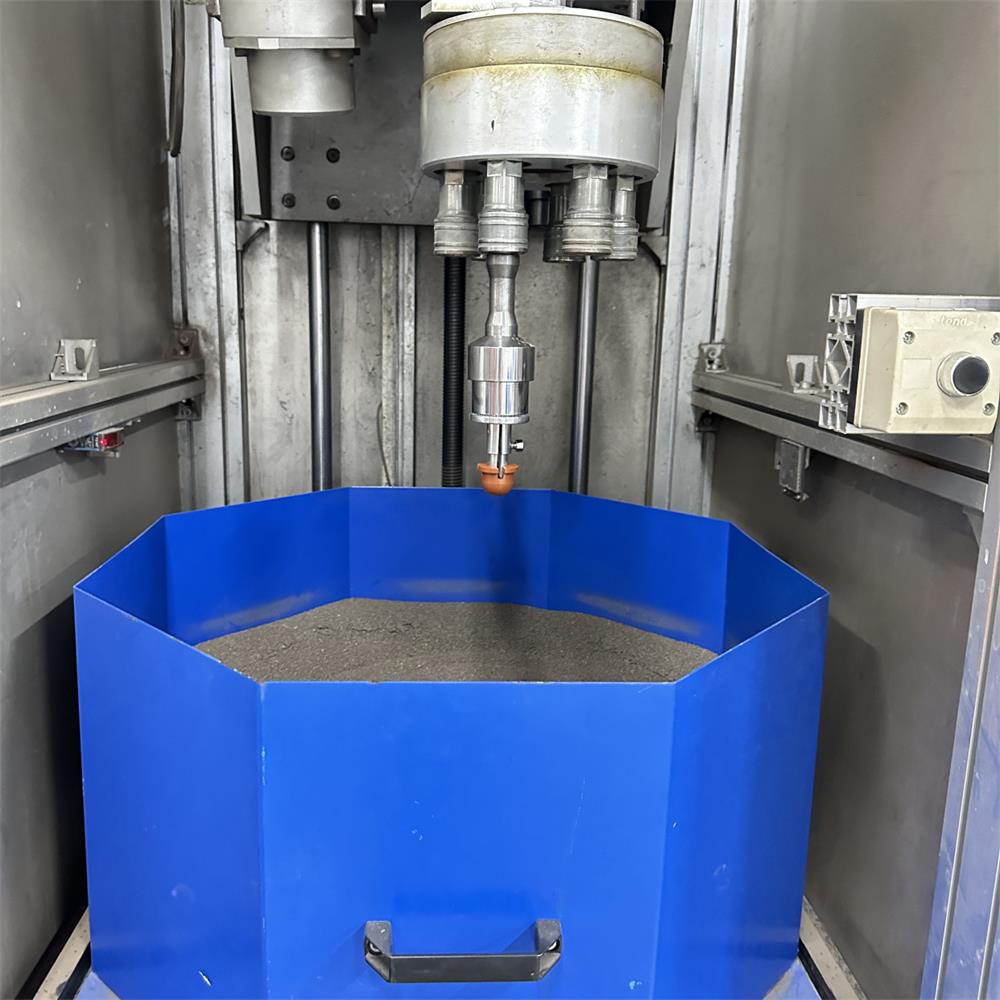
A blade edge rounding machine (also known as an edge preparation or edge honing machine) is a specialized post-processing device for cutting tools. It relies on fluid grinding, centrifugal vibration, or turbulent flow edge rounding principles to perform fine finishing of tool edges. Its unique working mechanism fundamentally optimizes the condition of blade edges, directly determining cutting stability, tool durability, and machining quality — making it a critical process for improving finished blade quality.
Core Principle: Fluid Micro-Grinding
The core principle of a blade edge rounding machine is fluid micro-grinding finishing. High-speed flowing abrasive media uniformly contacts and rubs against the blade edges, removing microscopic burrs and sharp corners left from grinding. During operation, the media conforms to all edges and grooves of the blade without dead zones, while preserving the base dimensions and original precision of the tool.
This principle overcomes the drawbacks of traditional manual polishing — which suffers from unevenness and large dimensional deviations — by forming uniform, smooth circular arc transitions on blade edges, fundamentally improving baseline blade quality.
Eliminating Edge Defects and Enhancing Impact Resistance
After precision grinding, blade edges are excessively sharp, with metal crystal structures exhibiting stress concentration. During cutting, these edges are highly susceptible to chipping and tooth loss. The edge rounding machine uses a uniform, micro-removal grinding principle to reshape sharp corners into standardized R-radius arcs, dispersing cutting impact forces and alleviating edge stress concentration.
Blades treated with edge rounding show a significant improvement in edge toughness, effectively preventing edge chipping during interrupted cutting and hard material machining, and substantially reducing the probability of tool scrapping.
Ensuring Batch Quality Consistency
The blade edge rounding machine employs a full-zone synchronous grinding working mode. Equipment rotation speed, media flow rate, and rounding time can all be precisely digitally controlled, ensuring that the rounding angle and material removal amount are highly uniform across all blades.
Compared to the random errors inherent in manual processing, the standardized working principle of the equipment eliminates issues such as uneven rounding of individual blades, localized over-grinding, or insufficient rounding. This ensures that batch blade edge conditions are consistent, maintaining uniform dimensional stability and workpiece surface finish across batch machining operations.
Improving Wear Resistance and High-Temperature Performance
Once blade edges are smooth and free of burrs, friction resistance during cutting is significantly reduced. This effectively minimizes built-up edge (BUE) formation and prevents iron chip adhesion to the edge, which can cause workpiece scratching and accelerated tool wear.
At the same time, the uniform circular arc edges provide a larger heat dissipation area, preventing concentration of cutting heat. This greatly enhances the blade's high-temperature resistance and anti-wear capabilities, effectively extending blade service life by more than 30%.
Conclusion
The micro-grinding and uniform finishing working principle of the blade edge rounding machine can eliminate edge defects, optimize edge geometry, unify batch quality, and enhance wear and impact resistance. Properly utilizing the edge rounding process improves overall blade quality, reduces machining costs, and ensures the high precision and stability required for CNC cutting operations.
Source: Shenzhen Zhongxun Precision Machinery Co., Ltd.